

WHEN WORK STOPS
What Strike Means to Us

A Country Held Still
Picture a Monday morning in Lagos. The Danfos are quieter than usual. The civil servant who lives on your street did not leave for work. The government hospital around the corner has its gates half-shut, patients turned away at the door, a handwritten notice taped to the wall: ‘We are on strike.’ In Abuja, federal buildings sit empty. Lecturers stay home. Doctors are at the union hall, not the ward. Markets slow. Students loiter at compound gates, unsure whether to go to school or go back inside.
This is Nigeria on strike. And it is not an uncommon scene.
From the Academic Staff Union of Universities (ASUU) to the Nigerian Medical Association (NMA), from the Nigeria Labour Congress (NLC) to the Trade Union Congress (TUC), work stoppages have become a recurring feature of national life. They are so routine that many Nigerians have learned to expect them — budget for them, even — the way they budget for power cuts or bad roads.
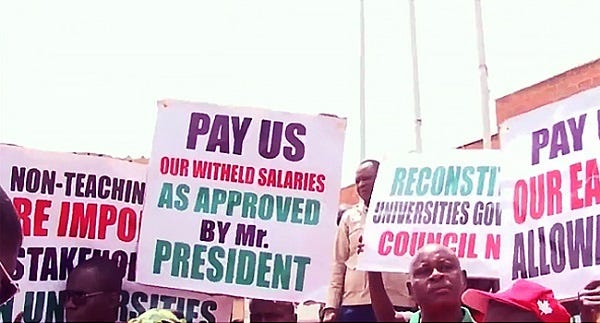
But behind the placards and the press releases is a deeper story: one of broken promises, underfunded institutions, and millions of ordinary people caught in the middle. When work stops in Nigeria, it is never just the workers who suffer.
Understanding the Strike: A Tool of Last Resort
A strike is a collective work stoppage — workers united in refusing to work until their employers or government meet certain demands. The concept is rooted in a simple truth: individually, workers have limited power, but together, they can bring an institution or an entire government to a standstill.
In Nigeria, hundreds of industrial actions have swept through education, health, oil, transport, and the civil service since independence. Their frequency reflects not worker militancy, but the persistent failure of the government to honour agreements and fund its own institutions.
A strike is not the beginning of a problem. It is the visible symptom of a problem that has been ignored for too long.
The major labour bodies — the NLC, TUC, ASUU, NMA, and others — are powerful enough to shut down entire sectors. And they have, repeatedly. Yet each shutdown is not merely an inconvenience for the powerful; it is a crisis for the ordinary citizen trying to get an education, seek medical care, or earn a daily living. This report examines what strikes mean to the average Nigerian: why they happen, how they unfold, and what they leave behind.
Why Workers Strike
The root causes are consistent: unpaid wages, decaying infrastructure, government failure to implement signed agreements, and a deep distrust earned over decades of broken promises. The lecturer whose laboratory has no equipment and who earns far less than a counterpart in Ghana or Kenya is not striking for drama. The doctor operating in a crumbling theatre without reliable oxygen is not being difficult. These are people who have reached the end of their institutional patience.
This cycle — negotiation, agreement, non-implementation, fresh crisis — is not accidental. It reflects a structural weakness in how the Nigerian state manages its relationship with organised labour, and until that structure changes, the strikes will continue.
EDUCATION
The ASUU Crisis: An Education on Hold
No single union has defined the Nigerian strike experience more sharply than the Academic Staff Union of Universities. ASUU has been on strike, cumulatively, for over five years since 1999. The 2020–2022 strike alone lasted eight months — the longest in Nigerian history — before being suspended following a court order. During that period, nearly two million students sat at home, their academic futures suspended along with their lectures.
The dispute between ASUU and the Federal Government centres on the implementation of the 2009 FGN–ASUU Agreement, which promised revitalisation funds for universities, improved salaries, and the introduction of an independent payment platform (UTAS) to replace GIFMIS, which ASUU argued exposed their members to undue government control and salary deductions.
Every semester lost is a life delayed. A generation that should be graduating is still waiting to resume.
For nearly two decades, successive governments have signed agreements with ASUU and then failed to implement them. Billions of naira promised for university revitalisation were either not released or released in incomplete tranches. The UTAS platform remained undeployed after years of back and forth. And lecturers watched their real incomes shrink as inflation eroded salaries that had not kept pace with economic realities.
The Young People Left Behind
The most visible casualties of ASUU strikes are students — a constituency Nigerian policymakers have consistently undervalued. When universities shut down, students dependent on bursaries face sudden financial crises. Final-year students lose momentum, often pushing back NYSC by a full year. Those on international exchange programmes lose placements they may never recover.
The psychological toll is often underdiscussed. A young person sent home indefinitely does not simply press pause on their life. They face family pressure, anxiety about falling behind peers, and, in many cases, exposure to idleness with few productive alternatives. Some enter informal economies. Some travel abroad and do not return. Nigeria loses them twice — first to the strike, then to emigration.
There is also the matter of academic quality. When universities reopen, lectures are rushed, exams compressed, and learning sacrificed in the rush to catch up. A semester meant to take four months is compressed into six weeks. The quality of graduates who emerge from this system is inevitably affected — and by extension, so is the country’s human capital.
The Ripple Effect: How Strikes Touch Everyone
The impact spreads far beyond campuses. Landlords near universities lose rental income. Cafeterias, bookshops, and print shops shut down or reduce staff. The local economies of mid-sized university towns — already far from major commercial centres — suffer disproportionately.
Parents who budgeted for four years of university suddenly bear an unplanned extension of financial responsibility. For the working poor — market traders, artisans, commercial drivers — who sacrificed to send a child to university, a strike is not an abstraction. It is a direct assault on the family’s investment in a better future.
HEALTH
When Doctors Walk Out: The Medical Strike
If educational strikes are damaging, medical strikes are potentially fatal. When healthcare workers down tools in Nigeria, the country’s already fragile public health system — strained by chronic underfunding, brain drain, and crumbling infrastructure — comes close to collapse. And it is the poorest Nigerians, who cannot afford private hospitals, who bear the cost with their lives.
The Nigerian Medical Association, the National Association of Resident Doctors (NARD), and various other health worker unions have declared strikes at federal, state, and sometimes local levels with regularity. The underlying grievances are familiar: unpaid allowances, the non-implementation of the Medical Residency Training Act, dangerous working conditions, and a government that makes commitments without the institutional will to honour them.
The 2021 NARD strike saw resident doctors abandon hospitals for months. Patients with scheduled surgeries were turned away. Emergency wards ran with skeleton staff. Pregnant women were redirected from government hospitals to private facilities, which they could not afford. In some cases, the delay in care was the difference between life and death.
A System Already on the Edge
Nigeria’s public health infrastructure operates far below the levels required to serve a population of over 200 million. There are fewer than 80,000 doctors in active practice — a figure that would need to multiply several times over to meet WHO-recommended ratios. Hospitals lack basic equipment. Pharmacies run out of essential drugs. Power outages interrupt surgeries and destroy temperature-sensitive medications.
Into this already stretched system, a medical strike introduces a crisis multiplier. The few healthcare workers who remain on duty — often junior staff and nurses not part of the striking union — are overwhelmed. Preventable deaths occur. Maternal mortality, already a national disgrace, worsens in the weeks that hospitals are understaffed.
The cruel irony is that the very government officials who delay implementing agreements have access to private hospitals, or more often, leave the country for treatment abroad. The people left to navigate the collapsed public system are the civil servants, subsistence farmers, and market traders — ordinary Nigerians who never had a seat at the negotiating table.
Brain Drain: The Permanent Strike
Medical strikes have accelerated an already alarming exodus of healthcare professionals. When a doctor weighs their conditions of service against an offer from a hospital in the United Kingdom, Canada, or Saudi Arabia, the logic of leaving is hard to argue with. In 2022 alone, hundreds of Nigerian doctors relocated abroad. The trend has not slowed.
This loss is not merely numerical. It strips the system of institutional knowledge, experienced specialists, and continuity in complex care. A country that loses its doctors to preventable systemic failures is not merely facing a strike problem; it is facing a public health emergency by slow accumulation.
Breaking the Cycle: A Call for Accountability and Dialogue
Nigeria does not have to live this way. The cycle of strike, negotiation, suspension, non-implementation, and fresh strike is not inevitable — it is a product of institutional failures that can be addressed, if the political will exists.
What is needed first is a culture of implementation. Signing agreements is not enough. What must change is the mechanism by which agreements are monitored, funded, and enforced. An independent body — with representation from unions, government, and civil society — tasked with tracking labour commitments would be a step toward accountability that neither side can easily escape.
Dialogue must also become proactive rather than reactive. Too often, the government only returns to the table after the damage has begun. Continuous, structured engagement that identifies grievances before they become flashpoints must replace the current pattern of crisis-driven negotiation.
The government must stop treating labour agreements as political theatre and start treating them as binding commitments to the Nigerian people.
The funding of public institutions — universities, hospitals, research bodies — must be treated as a national priority, not a bargaining chip. And young Nigerians, the students who lose years and the young doctors who inherit a broken system, must be recognised as stakeholders, not collateral damage.
A nation that continuously stops work to demand what it has already been promised is a nation at war with its own potential. Nigeria has the talent, the population, and the intellectual capacity to be remarkable. The strike must become the last resort it was always meant to be — not because workers should accept less, but because the government should finally deliver more.
So….
Do you think strikes in Nigeria are an effective way to demand change, or do they cause more harm than good? Tell us in the comments.
Found this helpful,